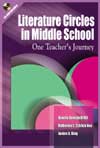
| Bonnie
Campbell Hill and Katherine Schlick Noe persuaded Janine King that
writing a book together about literature circles in Janine's middle
school classroom would be a simple project. And she fell for it.
We began by "picking her brain" as we met each month,
and Janine articulated how literature circles worked with middle
school students and how they had changed over time. Bonnie and Katherine
took notes and Janine collected student samples. We crafted drafts,
sent multiple e-mails back and forth, and the book slowly took shape.
Over
the years, the three of us have collaborated on numerous professional
presentations, and Bonnie and Katherine have co-authored other books
on literature circles. Yet, you'll hear just one voice in this book
– Janine’s. We wanted you to feel as if you're walking
into her classroom, listening in on her deliberations, and making
teaching decisions alongside her. We had to find a way to accomplish
this without overwhelming the book with voices or writing in the
distant third person. So the three of us wrote in the first person,
contributing equally to telling the story that unfolds.
The
Structure of This Book
When we read professional books, we don't want generalities. We
crave details and examples in order to picture how the ideas might
really work in a classroom. Therefore, we have included quotes and
writing from Janine’s students, and she has been honest about
her successes and failures. We have also tried to capture how literature
circles have changed in Janine’s classroom over the past few
years.
In
middle school, early adolescents are simultaneously honing their
reading and writing skills and trying to figure out their place
in the larger world. Chapter 1 sets a context for literature circles
with this unique and energetic age group. We explain where literature
circles fit in Janine’s middle school language arts curriculum
and how they meet some of the unique needs of young adolescents.
In chapters 2 and 3 we provide specific examples of how Janine plans
her literature circle units each year. We also talk about how she
selects books, including lists of some of the titles and literature
circle units she has found successful at various grade levels.
Conversation
is at the core of literature circles. We describe how Janine helps
students learn to talk about books independently in chapter 4. We
explain how she supports students' responses through writing in
chapter 5 and how she has changed the expectations and format each
year as she seeks to elicit quality work from her students. Chapter
6 addresses extending students' response to literature through the
arts. We have included lists of possible extension projects, as
well as ways that these responses can help students to dig deeper
into the books they are reading. In chapters 4 through 6, we include
specific focus lessons that Janine has used and examples of how
she evaluates students. We conclude each chapter with some last
thoughts about Janine’s next steps in her journey as a learner,
a teacher, a reader, and a writer.

Bonnie Campbell Hill, Katherine L. Schlick
Noe,
and Janine A. King
|
Also in this
series ...


|
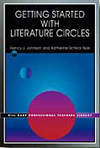
Getting
Started with Literature Circles
Katherine L. Schlick
Noe
and Nancy J. Johnson
© 1999 Christopher-Gordon
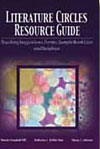
Literature
Circles Resource Guide
Bonnie Campbell Hill,
Katherine L. Schlick Noe, and
Nancy J. Johnson
© 2001 Christopher-Gordon
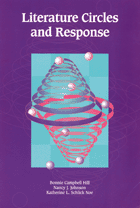
Literature
Circles and Response
edited by
Bonnie Campbell Hill, Nancy J. Johnson, and Katherine L. Schlick
Noe
© 1995 Christopher-Gordon |